On the eastern shore of Lake Garda — the Verona side — two small walled towns sit within easy reach of each other, and most first-time visitors end up asking the same question. Lazise or Bardolino? People who live around here will tell you it's the wrong question, but they will also have a strong opinion about which they prefer, and will defend that opinion at some length over a glass of Bardolino DOC. I have heard this conversation more times than I can count.
Eight kilometres apart along the lake road, they share the same medieval Scaligero past, the same olive groves on the slopes behind, the same view back across the water to Sirmione and the Brescian shore. They differ in size, in atmosphere, in what they offer for an afternoon, and in what happens to them in August. Below is the version of the conversation I usually have with friends who ask, with the parts where someone gets distracted by the wine list cut out.
Where the towns sit
If you draw a line down the eastern shore of southern Lake Garda, Lazise is the first walled town you reach coming up from Peschiera. Bardolino is the next one, eight kilometres further north. Garda — the actual town that gives the lake its name — comes after Bardolino. All three are within fifteen minutes of each other by car, twenty by the local bus, ninety on foot along the lakeside path.
For a single afternoon, you really only have to choose between Lazise and Bardolino. Garda is a different conversation: bigger, less compact, with a sense of being a town first and a destination second.
Lazise: smaller, older-feeling, gated
Lazise has about seven thousand residents and a historic centre you can walk across in ten minutes. It is the smaller of the two and more obviously medieval. Most of the walls are still there. So are the five gates. Where fishing boats once moored, the harbour is now full of pleasure craft, but its shape is the shape it had in the fourteenth century. Just behind it, the Romanesque church of San Nicolò dates from the twelfth century and looks every year of it: low, dark, square-shouldered.
Inside the walls, Lazise is tight. Streets narrow to single-file in places. A trattoria I have been going to since my early twenties — Alla Grotta, a few minutes from the harbour — does the same lake-fish menu my parents knew, and the same bigoli with sardines, and a wine list that is short and entirely Veronese. I would not call it a discovery. It is the opposite of a discovery.
For families with children
Lazise has Caneva Aquapark and Movieland just outside town, on the road toward Peschiera. In July and August this changes the demographic of the town considerably — lots of families on day trips, and lakeside cafés loud at lunchtime. If you are coming with children under ten and they want a water park, Lazise is unbeatable. If not, plan to arrive after four, when the day-trippers leave.
What Lazise does not have, in any quantity, is wine bars. There is wine, of course — you cannot move on this side of the lake without tripping over a Bardolino DOC bottle — but the culture of standing at a counter with a glass of Chiaretto and a plate of bresaola is not the Lazise way. Lazise sits down to eat. It does not stand up to drink.
Bardolino: longer, looser, wine-soaked
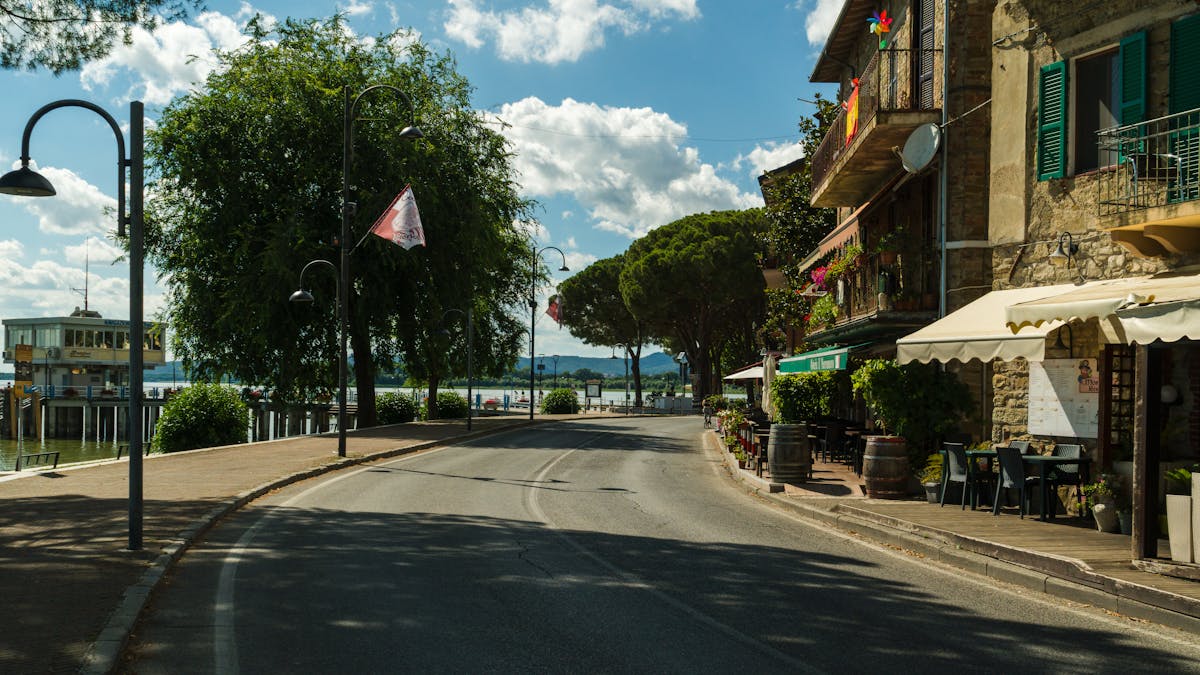
Bardolino is bigger — about eleven thousand residents — and feels it. Its lakeside promenade, the lungolago, runs for nearly two kilometres, lined with pollarded plane trees and outdoor cafés that put their tables almost into the water. The historic centre sits behind the lakefront and has its own Romanesque church, San Severo, also twelfth century, with frescoes inside that are worth ten minutes of anyone's attention. But the centre is less obviously walled than Lazise, less self-contained. You drift in and out of it without crossing a gate.
What Bardolino has, that Lazise does not, is a wine identity. Bardolino DOC — light, ruby-coloured, made mostly from Corvina and Rondinella grapes, designed to be drunk young and slightly cool — is named after the town. So is the Chiaretto, the rosé version, which I would put against any rosé from Provence and not lose. Wine bars sit on every other corner. A wine museum, the Museo del Vino at the Cantina Zeni just above town, is free and worth an hour. And the annual Festa dell'Uva e del Vino at the start of October fills the lakefront with stalls and tastings, one of the genuinely good wine festivals in northern Italy.
Bardolino's restaurants are, on average, more relaxed than Lazise's, with more outdoor seating and a wider range of styles. A wine bar I keep coming back to — Il Giardino delle Esperidi, just off the main square — does small plates with local cheeses and salumi, and a by-the-glass list long enough to keep you there for an evening. It is the kind of place that does not exist inside Lazise's walls, mostly because there isn't room.
A side-by-side
Both towns share the same Scaligero history, the same lake light, the same view west. What separates them is scale and tone. Below is the version I send to friends before they arrive.
| Feature | Lazise | Bardolino |
|---|---|---|
| Size | ~7,000 residents, compact | ~11,000 residents, longer along the lake |
| Vibe | Tight, walled, medieval | Open, promenade-led, wine-bar evenings |
| Key sights | City walls, San Nicolò, harbour | San Severo, the lungolago, wine museum |
| Food culture | Sit-down trattoria, family-run | Wine bars, small plates, outdoor tables |
| Best season | April–June, September | May–October (wine festival in early October) |
| Best for | An afternoon and a long lunch | An evening and a long aperitivo |
| Avoid in | July–August midday (water parks) | Festa weekend if you don't like crowds |
Walking between the two
On foot, the lakeside footpath connects Lazise to Bardolino in roughly an hour and a half. It is one of the more pleasant walks on the southern lake — flat, almost entirely shaded by plane trees in summer, with water on your left the whole way. Benches sit at intervals; two or three places stop you for coffee or gelato; the path passes a small olive grove and a couple of villas with private docks. I have done it many times, sometimes both directions in one day, with a long lunch in the middle.
By bus, if walking isn't appealing
ATV bus 64 runs between Lazise and Bardolino through the day, taking about fifteen minutes. Tickets are around two euros from the driver or from any tabaccheria. Service thins on Sundays and in winter, so check the timetable at the bus stop or on the ATV Verona website before relying on late-evening returns.
Lake ferries also stop at both towns from late spring to early October. A single hop is around four euros, and the views are obviously better than from the road. Ferries are the most civilised way to do the journey, but they don't run reliably in the shoulder seasons, and never in winter.
My answer: don't choose
People ask me which one I would pick if I only had a day, and the honest answer is that I would not pick. I would arrive in Lazise mid-morning, walk the walls, drink a coffee in the harbour, have an early lunch at a trattoria inside the gates, then either walk or take the bus to Bardolino in the early afternoon. Late afternoon and evening would happen on the Bardolino lungolago, with a glass of Chiaretto somewhere and dinner at a wine bar. That is the day I would design, and also the day I have actually had, repeatedly, with visitors over the last decade.
For a slower day on the western shore by way of contrast, see my Padenghe entry. For when to come — what each month actually looks like on the southern lake — there's a month-by-month read. And for the peninsula directly across the water, my Sirmione old-town walk covers the obvious comparison piece.
Useful pages: comune.lazise.vr.it for opening hours and event listings in Lazise; comune.bardolino.vr.it for Bardolino's wine festival dates; visitgarda.com for the regional tourism overview; and Lonely Planet's Lake Garda guide for a more general orientation.