Sirmione's old town is a peninsula. Two kilometres long, narrow, walled at one end, fortified all around, with a thirteenth-century Scaligero castle guarding the only land entrance and a Roman archaeological park at the far tip. Walked end-to-end without stopping, it takes about forty minutes. Walked properly — with detours into the small church, a coffee on a piazza, lakeside footpaths, and a half-hour at the Catullus grottoes — it's a half-day. I have done both versions, and the half-day is the one that actually rewards the trip.
Below is the walk in two forms: a fast version for travellers passing through, and the slow version I would do myself. Plus practical notes on the castle, the grottoes, where to stop for coffee, and when to come if you want to enjoy any of it.
The peninsula in brief
Sirmione juts out into the southern lake from the Lombard shore — a long thin spit of limestone with a medieval town packed onto its first half-kilometre and a Roman archaeological park on its last. Cars cannot enter the historic centre. The drawbridge of the castle marks the boundary, and beyond it is pedestrian-only, with the sole exception of resident vehicles and a small electric shuttle some hotels run for guests with luggage. This makes the peninsula one of the most pleasant things to walk in Italy, and also one of the most photographed, which means in summer it is essentially impassable between eleven and four.
Walking from drawbridge to tip, you pass, in order: the castle itself, Piazza Carducci, Via Vittorio Emanuele as the main spine, several small piazzas off it, the church of Santa Maria della Neve, Aquaria thermal complex on the right, a small public beach (Spiaggia Giamaica) on the left, and finally the Grotte di Catullo at the very tip, with their olive grove and panoramic views in three directions.
The Scaligero castle and the drawbridge
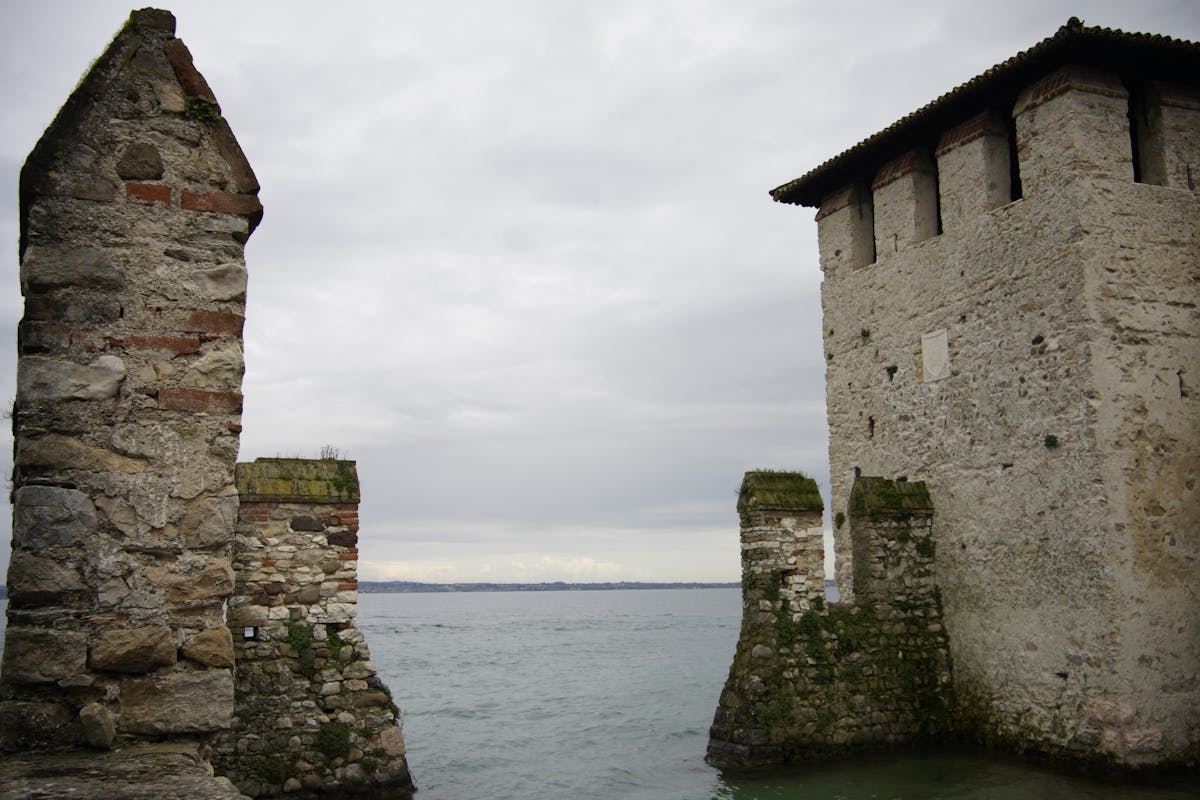
Sirmione's castle, the Castello Scaligero, was built by Mastino I della Scala roughly between 1259 and 1277, restored heavily in the 1930s, and is one of the few European castles entirely surrounded by water — its moat is the lake itself. You approach from the mainland, cross the wooden drawbridge over the moat, and enter through a fortified gate. Inside sit a courtyard, a tower you can climb (146 steps, dizzying view from the top), and a small museum about the Scaliger family who ruled Verona and most of the surrounding territory in the thirteenth and fourteenth centuries.
Entry to the castle is around six euros, four reduced. Open Tuesday to Sunday, closed Mondays. Climbing the tower is included with the ticket but adds twenty minutes — well worth it on a clear day, less interesting on a grey one. If your time on the peninsula is short, I'd skip the museum and do the tower only.
Forty-minute version
If you have a single hour on Sirmione — your tour bus has parked, your boat departs at three — here is the fast walk that gets you the essentials.
- Castle exterior — five minutes at the drawbridge for photos. Don't queue for the tower if time is tight.
- Piazza Carducci — the open square just past the gate, with cafés on three sides. Walk through, don't sit.
- Via Vittorio Emanuele — the main pedestrian street running the length of the peninsula. Walk it briskly, ten minutes.
- Santa Maria della Neve — a small fifteenth-century church on the right, often open, with frescoes worth a quick look.
- Up to the Catullus grottoes — fifteen-minute walk uphill to the entrance. If you don't have time to enter, the view from the gates is already remarkable.
- Back via the lakeside path — return on the western footpath rather than retracing Via Vittorio Emanuele. Faster, less crowded, much prettier.
Forty minutes if you're brisk. Fifty if you stop for a gelato. An hour gets you the headline acts.
Half-day version
This is my version, and the one I would actually do with someone visiting for the first time. It takes four to five hours and includes a coffee, a swim if it's warm, and a long visit to the grottoes.
- 9:00 — Coffee at Caffè Grand Italia on Piazza Carducci, ideally at one of the outside tables. Cappuccino, a brioche, the morning light coming through the plane trees.
- 9:30 — Castle visit, including the tower. Sixty minutes total — twenty for the courtyard, thirty for the tower and the views, ten for the small museum if it interests you.
- 10:30 — Slow walk along Via Vittorio Emanuele. Stop in Santa Maria della Neve, look at the fifteenth-century frescoes, sit for five minutes if it's empty.
- 11:15 — Lakeside detour on the western footpath. Quieter than the main spine, with views back to the castle from a different angle.
- 11:45 — Grotte di Catullo. Allow at least ninety minutes. The ruins, the olive grove, the museum, and the Spiaggia Giamaica below for a quick swim if it's the right month.
- 13:30 — Lunch back in the centre. Bar Marconi for something casual, La Speranzina or one of the lakeside trattorias for something longer.
Catullus grottoes at the tip
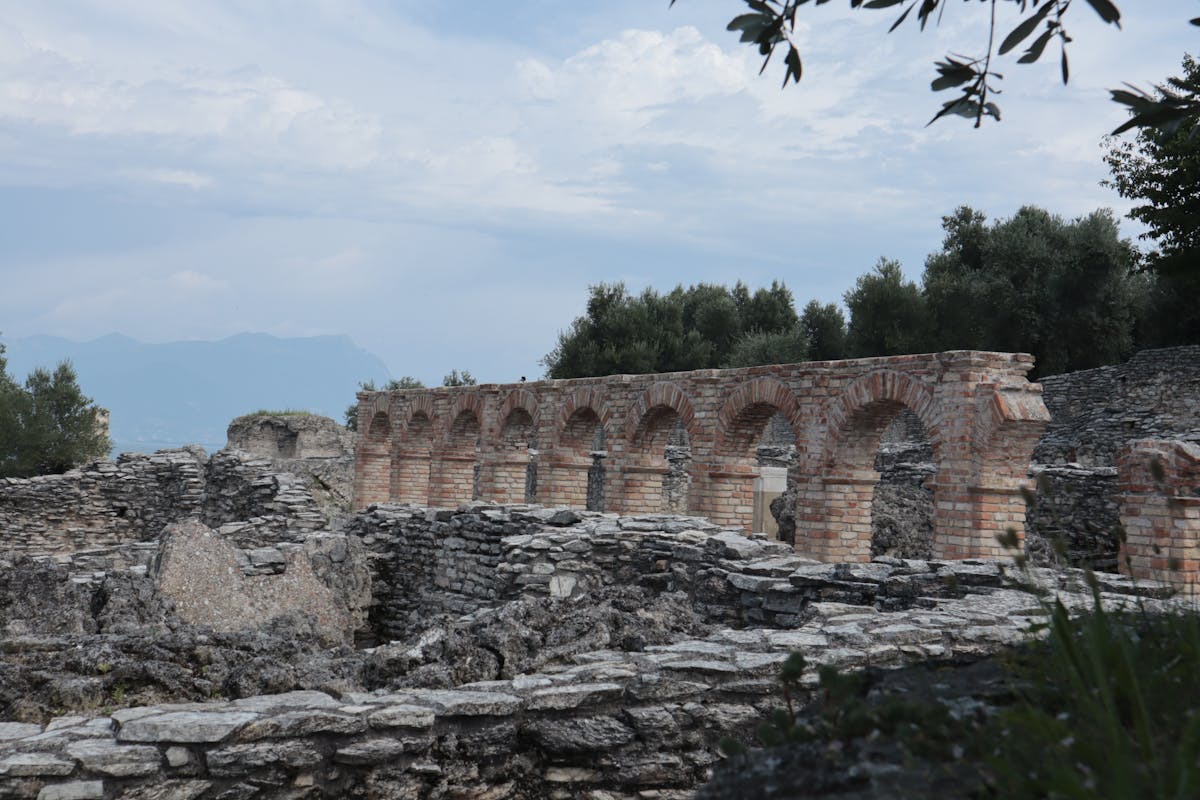
At the very end of the peninsula, on a small headland, sit the Grotte di Catullo: the largest preserved Roman residential complex in northern Italy. A vast first-century AD villa, possibly belonging to the family of the Roman poet Catullus (who wrote about Sirmio in his thirty-first poem), with foundations covering nearly two hectares, surrounded by an olive grove the regional authority maintains as part of the archaeological site.
"Paene insularum, Sirmio, insularumque ocelle" — Catullus, Carmen 31. "Sirmio, eyelet of all peninsulas and islands." The name has stuck for two thousand years. Whether the villa was actually his is uncertain; the name has stuck regardless.
You walk through the foundations on raised wooden walkways, pass through the small site museum (mosaics, frescoes, tools, a model of the original villa), and emerge into the olive grove with views over the lake to the south, west, and north. Limestone slabs lie at the water's edge — the Spiaggia Giamaica, technically a beach but really a low platform of pale stone the lake has polished smooth — and in summer people swim from them.
Practical: Grotte di Catullo
Open Tuesday–Sunday year-round, with seasonal hours (longer in summer, shorter from November to February). Entry around eight euros, six reduced, free on the first Sunday of every month for residents and EU citizens under twenty-five. Allow ninety minutes minimum. Updated hours and tickets at museilombardia.cultura.gov.it. The walk uphill from the centre takes fifteen minutes; a small electric shuttle runs in summer for those who can't.
When to come
I avoid Sirmione's old town in July and August between eleven in the morning and five in the afternoon. Outside that window, even in high summer, the peninsula is bearable — early-morning visitors before nine, evening visitors after six, both groups encountering a different and quieter version of the same place. Off-season, October through April, almost any time of day works.
Best months overall, in my book: late September and early October (warm enough to swim, light enough to sit outside in the evening, few tour buses); mid-March through mid-May (early spring light, almond and olive trees flowering, restaurants reopening); and a particular slot in late November when the day-tripper crowds have ebbed and the lake fog gives the peninsula a different character entirely.
For the longer thermal-water history that gives Sirmione its other identity, see my thermal history of Lake Garda. For the practical version of Aquaria and the Bóiola spring, the Sirmione thermal waters guide is the next read. And for which months actually make sense for a visit, the south Garda month-by-month covers what to expect from each.
Useful pages: museilombardia.cultura.gov.it for current Grotte di Catullo and castle hours; visitsirmione.com for the town's own listings; Lonely Planet's Sirmione page for general orientation; and Condé Nast Traveller's Lake Garda coverage for the wider luxury angle if that's relevant.